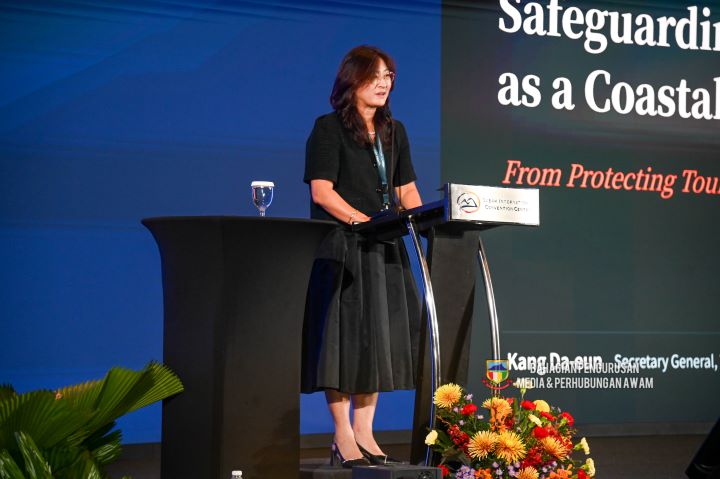
” TPO Secretary-General Kang Da-eun presents North Port redevelopment, marine assets, and climate response strategies at the Kota Kinabalu International Mayors’ Dialogue
” From the tourism appeal and safety management of ‘Bukangi’ to heat-related changes in beach tourism, Busan sets out a climate adaptation strategy
” Busan Dong-gu Mayor Kang Cheol-ho, representing a new TPO member city, proposes a ‘Coastal City Forum’

A shark known as “Bukangi” at Busan’s North Port, changes in the landscapes of Haeundae and Gwangalli amid extreme heat, and the transformation of North Port from a port area into a waterfront for residents: developments along Busan’s coast were presented at an international forum on future tourism strategies for coastal cities.
On October 12, the Tourism Promotion Organization for Global Cities (TPO) presented directions for sustainable tourism policy and urban development in response to climate change at the 2026 Kota Kinabalu International Mayors’ Dialogue (KKIMD) in Kota Kinabalu, Malaysia. The presentation drew on Busan’s marine assets and North Port redevelopment.

TPO Secretary-General Kang Da-eun spoke at the “Building Climate-Resilient Coastal Communities” session on “Safeguarding Waterfront Tourism as a Coastal Economic Asset.”
Kang presented the North Port redevelopment as an urban regeneration project that is reconnecting the sea with the city and opening the waterfront to residents and visitors. Port facilities, roads, and railways had long separated the sea from the urban center. The redevelopment is linking Busan Station, the cruise terminal, and the old downtown as a hub for marine tourism.
She also introduced the “Seven Principles for North Port Redevelopment,” recently announced by the Busan Port Authority. The principles set out key directions including strengthening North Port’s identity and sense of place; developing a hub for Busan’s future as a maritime capital; connecting the city and the sea; creating open spaces; supporting diverse activities; and establishing a sustainable operating system. Going beyond port development, the project aims to return the waterfront to residents and turn marine assets into a source of the city’s future competitiveness. It has drawn attention from coastal cities around the world as a model of urban regeneration.
Kang also discussed the shark recently sighted at North Port and affectionately nicknamed “Bukangi.” The sighting drew strong interest from residents and visitors in the waterfront, demonstrating the potential of marine ecosystems as a tourism asset while underscoring the importance of proactive safety management in response to ecological change. She emphasized that protecting the natural environment and ensuring the safety of residents and visitors must go hand in hand.
She addressed responses to extreme heat at Haeundae and Gwangalli, two of Busan’s beaches. As high summer temperatures change when and how people use the beaches, Kang said coastal tourism should adapt to the climate by expanding shaded areas and places to rest, developing evening tourism content, and operating facilities with climate conditions in mind.
The presentation also shared examples from TPO member cities: changes in apple-growing conditions in Batu, Indonesia, and mangrove forest restoration in Cần Giờ, Ho Chi Minh City, Viet Nam. Kang noted that climate change affects not only tourism resources but also local industries and residents’ livelihoods. She said tourism should go beyond attracting visitors to help protect marine environments and contribute to local economies and people’s lives. This approach is consistent with TPO’s Good Tourism vision, which considers visitor experiences, residents’ lives, environmental conservation, and the interests of future generations.
“Climate change is reshaping not only travel patterns but also the natural environments and local economies on which tourism destinations depend,” said Secretary-General Kang. “Tourism policy must go beyond protecting tourism from climate risks and be designed so that tourism contributes to safeguarding cities’ natural environments and local communities.” She added, “TPO will share experience and solutions among cities and help translate them into tourism policies that each city can put into practice.”

Busan Dong-gu Mayor Kang Chul ho, whose district became a new TPO member city this year, also attended the forum at the invitation of the Mayor of Kota Kinabalu. At the Mayors’ Roundtable, he proposed establishing a “Coastal City Forum” to help coastal cities address shared challenges, including climate change, marine conservation, and sustainable tourism. Busan Dong-gu is home to a concentration of maritime, historical, and cultural tourism assets, including the North Port Redevelopment Area, Busan Station, the Cruise Terminal, Chinatown, and Hillside Neighborhoods. His participation provided an opportunity to broaden exchanges and cooperation among coastal cities as Busan Dong-gu joined the TPO network.
Headquartered in Busan, TPO is the only international organization in the Republic of Korea dedicated to tourism. Busan Metropolitan City currently serves as its President City, with Gimhae City and Kota Kinabalu City serving as Co-President Cities. Established in 2002, TPO has grown into a global platform for city tourism cooperation, bringing together 117 cities and 67 public and private organizations across 18 countries. Through policy cooperation, joint projects, and knowledge sharing, TPO advances Good Tourism, an approach that draws on data-informed policymaking and digital transformation to create positive value for urban economies, culture, communities, and the environment.


Leave a Reply